For many years, video games have been viewed as a predominantly male hobby. Gaming advertisements, conventions, competitive communities, magazines and online discussions have historically centred on boys and young men.
Even today, men are generally more likely to describe gaming as one of their primary hobbies, spend long hours playing competitive games and publicly identify themselves as “gamers.”
However, saying that women simply do not enjoy video games would be misleading.
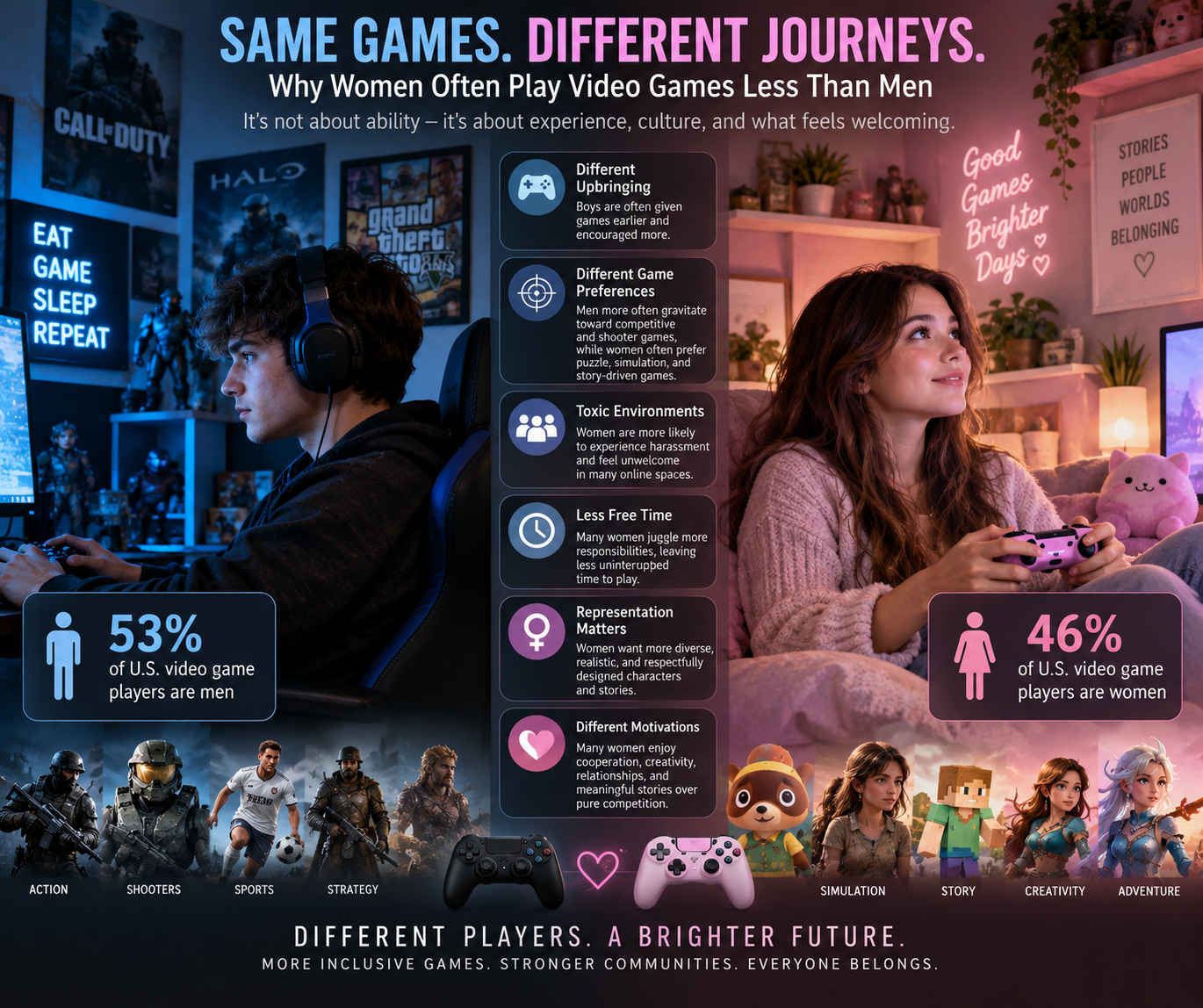
The Entertainment Software Association’s 2026 survey found that women represented approximately 46 per cent of American video game players, compared with 53 per cent who were men. Gaming participation is therefore much closer to equal than popular stereotypes suggest.
The difference is often found in how frequently people play, which games they choose, how strongly they identify with gaming culture and whether gaming becomes a central part of their social identity.
Men and women are not two completely uniform groups. Some women play competitive games for thousands of hours, while many men have almost no interest in gaming. Nevertheless, several social, cultural and design factors help explain the average differences that continue to appear.
Women Play Games More Than People Realize
One reason women appear less interested in video games is that society often uses a narrow definition of gaming.
Someone who spends hundreds of hours playing competitive shooters, strategy games or online role-playing games is immediately recognized as a gamer. A woman who regularly plays puzzle games, mobile games, life simulations or social games may not receive the same label—even from herself.
This creates a distinction between playing games and identifying as a gamer.
A 2015 Pew Research Center survey found that men and women reported playing games at nearly identical rates, but men were more than twice as likely to say that the word “gamer” described them well. Although the figures are older, the study demonstrated that participation and identity are not necessarily the same thing.
A similar gap appears among teenagers. Pew’s 2024 survey found that 97 per cent of teenage boys and approximately three-quarters of teenage girls played video games. However, 62 per cent of boys identified as gamers, compared with only 17 per cent of girls.
Many women therefore play video games without making gaming part of their public identity.
Gaming Was Historically Marketed Toward Boys
Modern gaming did not become male-dominated purely because boys naturally discovered games while girls ignored them.
For decades, consoles and major releases were aggressively marketed toward boys. Video games were frequently placed in boys’ sections of toy stores, advertised in magazines aimed at boys and presented using themes of aggression, competition, technology, power and sexualized women.
This created a feedback loop.
Companies believed boys were the most reliable customers, so they produced and advertised more games for boys. Because more boys felt invited into gaming, they became the largest visible audience. The industry then used that audience as proof that games should continue being designed primarily around male preferences.
Girls certainly played early arcade and console games, but gaming culture gradually became connected to ideas about boyhood, masculine competition and technological skill. Historical research into arcade culture has identified the importance of this association between video games and male youth culture.
When one group is encouraged from childhood to view a hobby as “theirs,” it is unsurprising that its members are more likely to develop strong skills, memories and identities around it.
Boys Often Receive Games Earlier
Early exposure matters.
A boy may receive a console, computer or handheld system at a young age because his parents assume that boys enjoy technology and video games. He may then spend years learning game controls, developing spatial familiarity and discussing games with friends.
A girl may be given different toys and encouraged toward different activities. Even when she has access to the same family console, it may unofficially belong to her brother.
By adolescence, the boy may have accumulated thousands of hours of experience. Games feel natural and familiar to him. The girl may encounter the same game and feel that she is entering an established culture in which everyone else already understands the rules.
Research involving young players has found that girls can feel less encouraged than boys to play because of their gendered experiences around gaming.
This does not necessarily mean girls lack the ability or interest. They may simply receive less early encouragement, fewer invitations and fewer opportunities to build confidence.
Many Major Games Were Designed Around Male Preferences
For much of gaming history, the most heavily promoted genres were shooters, military games, fighting games, sports games, strategy games and action adventures.
These genres are not exclusively masculine. Millions of women enjoy them. However, average genre preferences do show differences.
A large 2021 study found that men were more likely to prefer first- and third-person shooters, westerns, shoot ’em ups, strategy games, open-world games and sports games. Women showed stronger average preferences for music, dance, quiz, educational, casual, simulation, puzzle and platform games.
These are average tendencies rather than rules. They also do not prove that the differences are biological. Preferences can develop through marketing, childhood exposure, peer groups, cultural expectations and the types of experiences people are encouraged to value.
The problem is that games marketed as major or “serious” releases have traditionally come from the genres more strongly associated with male players.
A woman who enjoys The Sims, Animal Crossing, mobile puzzles, visual novels or life simulations may be dismissed as a casual player. A man who plays competitive shooters is more likely to be treated as a legitimate gamer.
Gaming culture has therefore sometimes confused male genre preferences with gaming itself.
Competition May Be Less Appealing to Some Women
Traditional gaming culture frequently emphasizes winning.
Players compare rankings, completion times, kill-to-death ratios, rare equipment, trophies and competitive skill. Online games may require constant practice to avoid falling behind.
Some people find this highly motivating. Others experience it as unnecessary stress.
Earlier research into women’s game preferences found that female respondents were, on average, less attracted to competitive features. The same research identified limited meaningful social interaction, violent content and sexualized gender stereotypes as reasons some women disliked particular games.
This does not mean women dislike challenge. Games such as puzzle adventures, farming simulations and management games can be extremely complex.
The distinction may be between mastery and domination.
A player may enjoy solving difficult problems, building something beautiful or developing a character without wanting to defeat strangers, humiliate opponents or prove superiority through a public ranking.
When gaming culture treats aggressive competition as its highest form of achievement, people with different motivations can feel that the medium is not speaking to them.
Women May Look for Different Forms of Social Interaction
Many games claim to be social because they include multiplayer modes. However, multiplayer competition is not necessarily the type of social interaction everyone wants.
A competitive game may involve shouting commands at strangers, blaming teammates for mistakes and attempting to defeat another group. That is social interaction, but it is often hostile and narrowly focused.
Some women may prefer games that allow cooperation, relationship building, storytelling, creativity or shared exploration.
This helps explain the appeal of games such as:
The Sims, Animal Crossing, Stardew Valley, Final Fantasy XIV, Life Is Strange, narrative role-playing games, visual novels and cooperative adventures.
These games can provide opportunities to personalize characters, develop relationships, build communities and create stories.
The popularity of such games suggests that many women do not dislike interactive entertainment. They may simply be less attracted to the competitive and combat-heavy experiences that have historically dominated the industry’s public image.
Online Harassment Can Make Gaming Less Enjoyable
A man playing an online game may be insulted because he performs badly. A woman can receive the same criticism while also facing comments about her gender, appearance, sexuality or supposed lack of gaming ability.
Some women avoid voice chat, use gender-neutral usernames or play male characters so other players will not immediately identify them as female.
Research has found that women who experience online harassment are considerably more likely than men to believe they were targeted because of their gender. Women are also more likely to report sexual forms of online harassment.
One 2026 study of women and transgender or gender-diverse competitive gamers reported that approximately 87 per cent of participants had experienced gender-related harassment. Because this concerned a particular competitive-gaming sample, it should not be interpreted as representing every female player, but it illustrates how hostile some gaming environments can become.
Even when harassment does not force someone to stop playing, it can change how she plays.
She may avoid voice communication, refuse to join competitive teams or remain within private groups of trusted friends. Consequently, she becomes less visible in the public gaming community, reinforcing the false impression that women are not playing.
Female Characters Have Not Always Been Inviting
For many years, female characters in games were commonly presented as:
- Princesses waiting to be rescued
- Secondary romantic interests
- Sexual rewards for male protagonists
- Exaggerated fantasy figures
- Physically weak support characters
- Background decoration
Male players were normally offered a wide variety of identities: soldiers, adventurers, criminals, athletes, explorers, ordinary people, antiheroes and reluctant heroes.
Female players were often given fewer choices. Even when a woman was playable, her design might appear primarily intended to attract a heterosexual male audience rather than help female players identify with her.
Representation does not mean every woman needs to play as a woman. Women can enjoy controlling male protagonists, just as men can enjoy playing female characters.
The issue is whether the fictional world appears to recognize women as complete participants or treats them primarily as objects within a male fantasy.
Games with customizable protagonists, meaningful female characters and broader emotional themes can make the medium feel more welcoming without excluding men.
Some Women Have Less Uninterrupted Leisure Time
Many traditional console and computer games require long, uninterrupted sessions.
A major role-playing game may take more than 100 hours to complete. Competitive games require regular practice. Online raids may demand that players remain available at particular times.
These formats are easier to enjoy when a person controls large blocks of leisure time.
Women, especially women raising children or managing households, may have less uninterrupted personal time. Canadian time-use research continues to find that women perform more unpaid housework than men on average, even under different work arrangements.
This may help explain why shorter and more flexible games can be attractive.
A mobile puzzle, simulation or turn-based game can be played for ten minutes and stopped immediately. It does not require a headset, a gaming room or several uninterrupted evening hours.
A preference for mobile or casual games should not automatically be interpreted as weaker interest. It may reflect the amount and type of leisure time available.
Gaming Communities Can Make Women Feel They Must Prove Themselves
A male player is usually assumed to be a genuine gamer until he demonstrates otherwise.
A woman may be expected to prove that she knows enough.
She may be questioned about which games she has completed, whether she plays on an “appropriate” platform or whether she is participating merely to receive attention. If she plays casual games, she may not be considered legitimate. If she plays competitive games, her ability may be doubted.
This creates an exhausting contradiction.
Women are told that they do not play real games, but when they enter supposedly real gaming spaces, they can be treated as outsiders.
Some decide it is easier to enjoy games privately without adopting the gamer label.
Biological Explanations Are Usually Too Simple
It is possible that average differences in temperament, competitiveness or interests contribute to some gaming preferences. Men and women are not identical populations.
However, biology alone cannot explain why gaming participation changes across cultures, generations, genres and platforms.
When a game such as The Sims or Animal Crossing attracts enormous numbers of female players, it demonstrates that women are entirely capable of becoming deeply involved in interactive worlds.
When women become enthusiastic players after being introduced to the right game, it suggests that the barrier was not an inability to enjoy games. It was a mismatch between the person and the games previously offered to her.
Preferences emerge from a mixture of personality, childhood experience, social expectations, marketing, available time, community behaviour and game design.
Reducing all of that to “men naturally like games more” ignores how gaming culture was created.
Women May Prefer Games Without Preferring Gamer Culture
The most important distinction may be between video games and the surrounding culture.
A woman might enjoy:
- Exploring an open world
- Developing relationships with fictional characters
- Building a house or community
- Solving mysteries
- Customizing an avatar
- Playing cooperative games with friends
- Experiencing an emotional story
- Relaxing with a mobile game
At the same time, she may dislike:
- Angry voice chat
- Competitive rankings
- Gatekeeping
- Sexualized advertising
- Endless grinding
- Aggressive monetization
- Male-dominated communities
- Being expected to prove her knowledge
She is not necessarily rejecting video games. She is rejecting the version of gaming that has been presented as normal.
The Gap Is Already Changing
Gaming is now much broader than it was during the arcade, early-console and gaming-magazine eras.
Mobile phones have placed games in nearly everyone’s hands. Life simulations, narrative adventures, cooperative games, virtual reality, creative platforms and accessible independent titles have expanded what a video game can be.
Women are also increasingly visible as developers, writers, artists, streamers, competitors and community organizers.
As the medium offers a wider range of fantasies, social experiences and forms of challenge, the old gender divide becomes less useful.
The future of gaming is unlikely to be one in which women gradually learn to enjoy the exact same games men traditionally preferred.
It will be one in which the definition of gaming expands.
Final Thoughts
Women do not universally prefer video games less than men.
Men are still more likely to make gaming a central hobby, identify publicly as gamers and participate heavily in certain competitive genres. However, women already constitute a very large part of the gaming population.
The apparent difference is influenced by decades of male-focused marketing, unequal childhood exposure, different genre preferences, competitive culture, harassment, representation and the availability of leisure time.
Some women genuinely have little interest in games, just as some men do. Others enjoy games but dislike conventional gamer culture. Many simply prefer different forms of interactive entertainment.
The better question is therefore not:
Why don’t women enjoy video games?
It is:
What kinds of games and gaming communities make different people feel invited to play?
Once games provide the right experience, women are not difficult to attract.
Many of them were already playing.