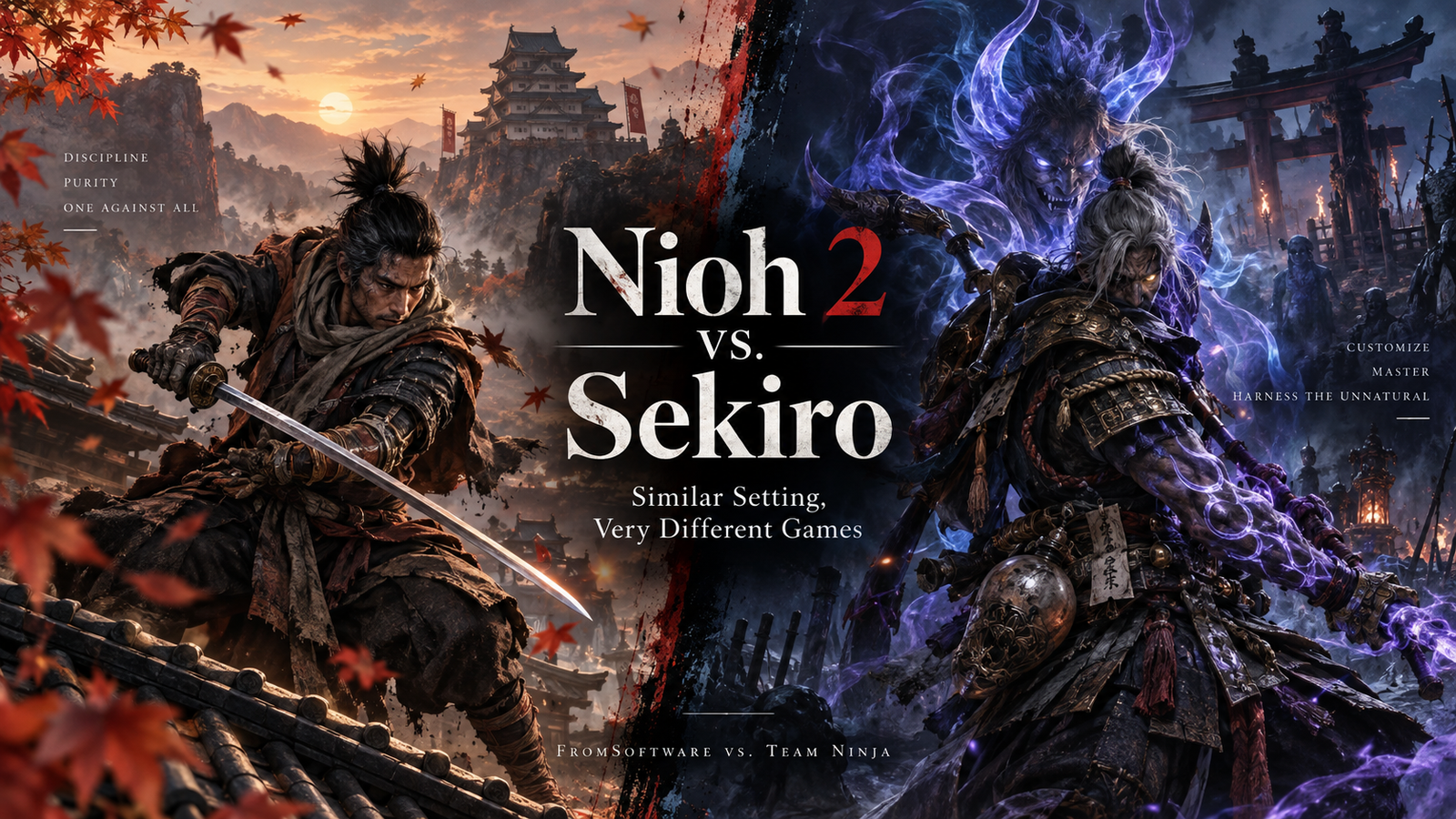
At first glance, Nioh 2 and Sekiro: Shadows Die Twice look like close relatives. Both are brutally difficult action games set in heavily stylized versions of historical Japan. Both feature samurai, supernatural creatures, punishing bosses, precise melee combat, and a strong emphasis on mastering enemy attack patterns.
It is therefore easy to assume that the two games came from the same developer.
They did not.
Sekiro: Shadows Die Twice was developed by FromSoftware, the Japanese studio behind Dark Souls, Bloodborne, Armored Core, and later Elden Ring. Activision published Sekiro internationally.
Nioh 2, meanwhile, was developed by Team Ninja, the studio best known historically for Ninja Gaiden and Dead or Alive. Team Ninja operates under Koei Tecmo.
That difference in lineage explains why the two games, despite their surface similarities, ultimately feel very different.
Sekiro Comes From the FromSoftware Tradition
Sekiro is recognizably a FromSoftware game, but it is arguably one of the studio’s most unusual.
Unlike Dark Souls or Elden Ring, Sekiro does not give the player dozens of weapon classes or hundreds of pieces of equipment. You play a defined protagonist known as Wolf, and his katana remains the central weapon throughout the game.
Instead of creating a character build capable of solving a problem in multiple ways, Sekiro asks the player to become better at one highly refined combat system.
The centerpiece is deflection.
Enemies have a posture meter, as does the player. Properly timed deflections damage an opponent’s posture until an opening appears for a lethal deathblow.
As a result, Sekiro combat often resembles a sword duel more than a conventional action RPG.
A difficult boss might initially appear impossibly fast. After repeated attempts, however, the player begins recognizing the rhythm:
attack, deflect, deflect, counter, jump, Mikiri counter, attack.
Eventually a fight that once seemed chaotic becomes remarkably controlled.
This is one of Sekiro’s defining characteristics. The character may acquire new abilities, but much of the real progression happens inside the player.
You become better at playing Sekiro.
Nioh 2 Comes From Team Ninja’s Action-Game Heritage
Nioh 2 takes almost the opposite approach.
Team Ninja has decades of experience creating extremely fast, technically demanding combat systems, particularly through the Ninja Gaiden series.
That heritage is immediately noticeable in Nioh 2.
The game contains numerous weapon types, including swords, dual swords, spears, axes, kusarigama, switchglaives, tonfa, odachi and others.
Each weapon effectively has its own combat system.
Players also fight using three stances:
- High stance
- Mid stance
- Low stance
Changing stance affects attack speed, damage, mobility and available techniques.
Then there is the Ki system, Nioh’s equivalent of stamina. Through a mechanic known as the Ki Pulse, players can rapidly recover Ki after attacking.
Advanced players eventually learn to combine stance switching, Ki Pulses, weapon skills and movement into long chains of attacks.
This makes Nioh 2’s combat substantially more mechanically complicated than Sekiro’s.
Sekiro asks:
Can you master this duel?
Nioh 2 asks:
What combat system do you want to build and master?
Nioh 2 Is Much More of an RPG
Perhaps the largest difference between the games is character customization.
Sekiro contains progression systems, but it is not primarily a loot-driven RPG.
Nioh 2 absolutely is.
Enemies constantly drop weapons and armor with different rarity levels, statistics and special effects. Players invest points into attributes, develop weapon-specific skill trees and construct increasingly specialized builds.
Nioh 2 also incorporates:
- Onmyo magic
- Ninjutsu
- Guardian Spirits
- Soul Cores
- Yokai abilities
- Yokai Shift
- elemental damage
- equipment set bonuses
- weapon scaling
- extensive endgame builds
A player might specialize in lightning damage, heavy armor and axes.
Another might use light armor, ninjutsu and kusarigama.
Another might focus heavily on magic.
Yet another could create an aggressive dual-sword build centered around Ki destruction.
This creates tremendous replay value because changing weapons or builds can fundamentally alter how the game feels.
Nioh 2 Has a Little Diablo in Its DNA
Another important distinction is loot.
Nioh 2 throws equipment at the player constantly.
Weapons can possess different bonuses, elemental effects, rarity tiers and stat combinations. Endgame progression becomes increasingly concerned with optimizing equipment.
In this sense, Nioh 2 could almost be described as:
Dark Souls meets Ninja Gaiden meets Diablo.
That loot-heavy structure will appeal enormously to some players and irritate others.
Players who enjoy examining statistics and optimizing builds can spend hundreds of hours experimenting.
Players who simply want to fight may occasionally feel like they spend too much time examining inventories.
Sekiro avoids almost all of this.
There is very little equipment management. The game keeps the player’s attention focused almost entirely on exploration and combat.
Sekiro Is More Focused
Sekiro’s comparative simplicity is intentional.
Because every player essentially possesses the same primary weapon and core abilities, FromSoftware can design encounters around a relatively predictable set of player capabilities.
That allows Sekiro’s boss encounters to be extraordinarily precise.
The developers know that you have a katana.
They know you can deflect.
They know you can jump.
They know you have access to the Mikiri Counter once unlocked.
Therefore bosses can be designed almost like elaborate martial-arts puzzles.
Nioh 2 must accommodate a much wider variety of builds.
Its challenge frequently involves understanding the game’s systems as much as memorizing a boss.
The Treatment of Japanese Mythology Is Also Different
Both games take inspiration from Japanese history and folklore, but Nioh 2 leans much more heavily into the supernatural.
Nioh’s world is overflowing with yokai.
Players encounter supernatural creatures derived from Japanese folklore, mythology and religious traditions. Guardian Spirits accompany characters, Soul Cores provide demonic abilities, and the protagonist can partially transform into a yokai.
Sekiro also contains monsters, spirits, immortality and supernatural locations, but much of its presentation remains centered on the story of a shinobi navigating a collapsing Japanese kingdom.
Nioh 2 frequently feels like Japanese mythology has exploded directly into the battlefield.
For players interested in yokai folklore, Shinto imagery and supernatural interpretations of Japanese history, Nioh 2 has enormous appeal.
Their Historical Settings Differ Too
Although both games evoke feudal Japan, they are not simply telling variations of the same story.
Nioh 2 loosely incorporates real historical personalities and events from Japan’s Sengoku period while mixing them heavily with fantasy.
Characters based on figures such as Oda Nobunaga, Toyotomi Hideyoshi and Tokugawa Ieyasu appear within its fictionalized history.
Sekiro takes place in the fictional land of Ashina. While its world clearly draws inspiration from Japan’s Sengoku era, FromSoftware has considerably more freedom because Ashina is fundamentally its own fictional setting.
Nioh therefore feels somewhat like supernatural historical fiction.
Sekiro feels more like an original dark fantasy inspired by Japanese history.
Difficulty Works Differently
Both games are difficult, but their difficulty comes from different sources.
Sekiro can feel especially unforgiving because players cannot easily build their way around a challenge.
You cannot normally spend several hours collecting better armor and suddenly overpower a difficult swordmaster.
At some point, you have to learn the fight.
That makes Sekiro frustrating until its combat system clicks.
Once it does, however, the game can become surprisingly elegant.
Nioh 2 gives players considerably more options.
If an encounter becomes difficult, the player can:
- upgrade equipment,
- change weapons,
- alter their build,
- use magic,
- use ninjutsu,
- exploit elemental weaknesses,
- equip different Soul Cores,
- summon assistance,
- or simply become mechanically better.
Ironically, however, Nioh 2 may ultimately possess the higher mechanical ceiling.
Advanced Nioh players combine stance switching, animation cancels, Ki management, weapon skills and Yokai abilities with a level of complexity that Sekiro rarely requires.
Sekiro Is About Mastery; Nioh 2 Is About Mastery and Experimentation
This may be the easiest way to understand the difference.
Sekiro gives the player a carefully designed sword-fighting system and asks them to master it.
Nioh 2 gives the player a massive toolbox and asks them what they want to do with it.
A Sekiro player eventually feels like an expert shinobi.
A Nioh 2 player may eventually feel like a combat engineer.
Which Game Is Better?
There is no obvious winner because the games pursue different goals.
Choose Sekiro: Shadows Die Twice if you prefer:
- tightly designed sword combat,
- parrying and deflection,
- minimal equipment management,
- carefully constructed boss duels,
- a focused single-player experience,
- and progression based heavily on personal mechanical improvement.
Choose Nioh 2 if you prefer:
- large numbers of weapons,
- complex character builds,
- extensive loot,
- magic and ninjutsu,
- Japanese supernatural mythology,
- cooperative multiplayer,
- and extremely deep combat experimentation.
Players who enjoy both styles may discover that the games complement each other rather than compete directly.
Similar Appearance, Different DNA
The confusion between Nioh 2 and Sekiro is understandable.
Put screenshots of the two games beside each other and both contain armored warriors, Japanese castles, swords, demons and intimidating bosses.
Underneath, however, their design philosophies come from very different histories.
FromSoftware took its reputation for deliberate, punishing action games and stripped much of the traditional RPG structure away to create an unusually concentrated sword-fighting experience.
Team Ninja took its background in fast technical action games and combined it with Souls-inspired exploration, Diablo-style loot and an enormous RPG system.
The result is two very different interpretations of the difficult samurai action game.
Perhaps the simplest comparison is still the most useful:
Sekiro is a highly refined samurai duel.
Nioh 2 is a giant Japanese action-RPG combat laboratory.
They may look like relatives, but they definitely do not have the same parents.