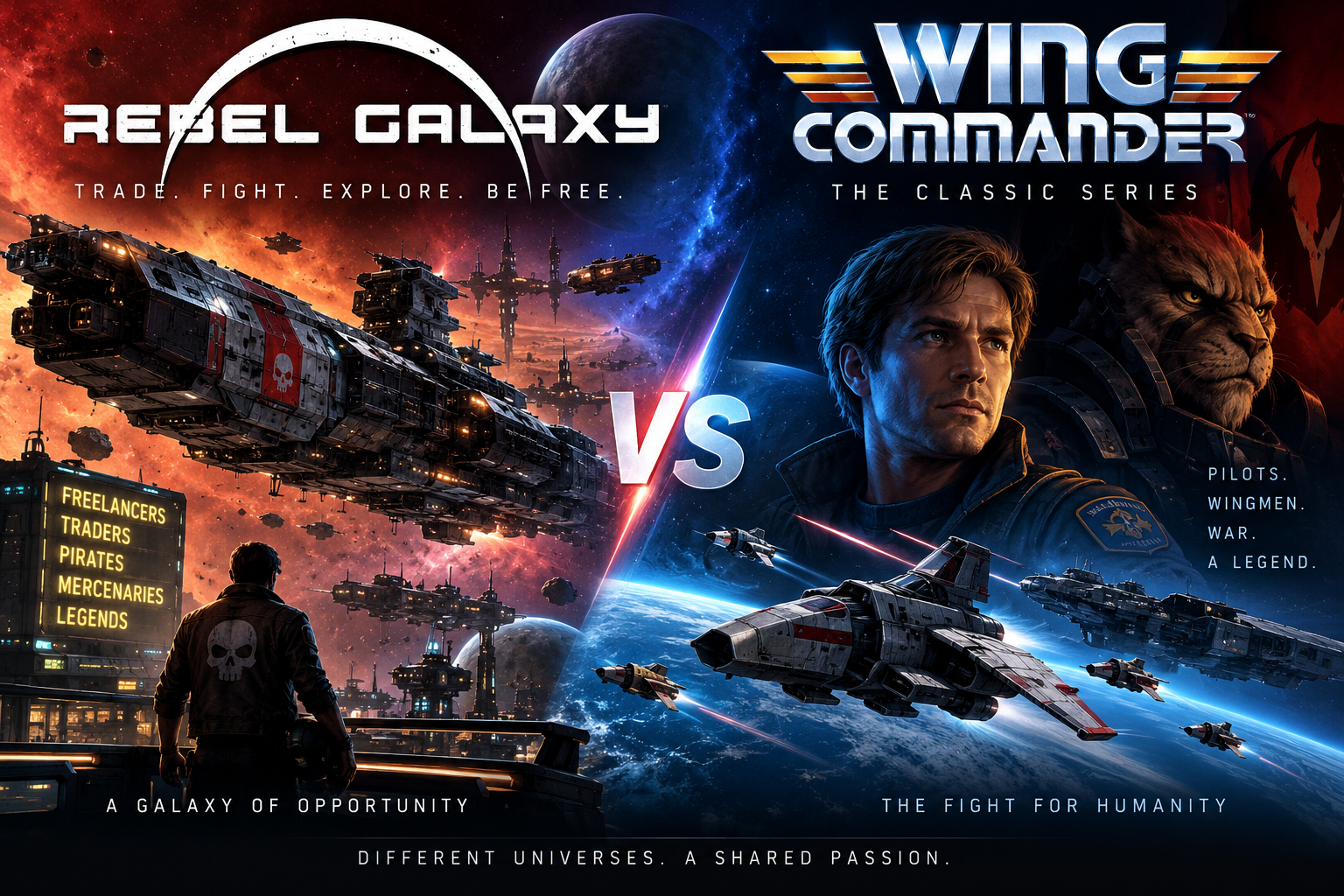
At first glance, Rebel Galaxy and Wing Commander appear to belong to the same tradition.
Both place the player behind the controls of an armed spacecraft. Both feature dangerous frontiers filled with merchants, mercenaries, pirates, military forces, and alien factions. Both allow players to upgrade their ships, accept missions, travel between systems, and become increasingly powerful.
However, actually playing them reveals an important difference.
The original Rebel Galaxy is not really a modern version of the numbered Wing Commander games. Its open-world structure is much closer to Wing Commander: Privateer, while its combat is unlike almost anything in the Wing Commander franchise.
Wing Commander generally asks:
What would it feel like to be a fighter pilot in a military space opera?
Rebel Galaxy asks:
What would it feel like to captain a heavily armed naval vessel on the lawless frontier?
The games share some of the same DNA, but they express it through completely different fantasies.
The Largest Difference: Fighter Pilot Versus Starship Captain
In the main Wing Commander games, the player usually controls a relatively small fighter launched from a military carrier.
Combat is built around three-dimensional dogfighting. You chase enemy fighters, turn toward targeting reticles, manage missiles and guns, protect wingmen, escort larger ships, and attack vulnerable sections of enemy capital vessels.
You are important, but you are still one pilot within a larger military organization.
Rebel Galaxy places the player in command of a much larger ship. The game emphasizes destroyers, frigates, cruisers, and eventually enormous warships. Combat is restricted largely to a horizontal plane and is designed to feel more like a naval battle than an aerial dogfight. Players manoeuvre alongside enemy vessels, expose a broadside, fire heavy volleys, manage shields and turrets, and attempt to protect damaged sections of their ships.
That single decision changes the entire feeling of combat.
Wing Commander combat is personal and immediate. You are looking through a cockpit canopy while an enemy fighter attempts to get behind you.
Rebel Galaxy combat is heavier and more deliberate. You are positioning an entire vessel, selecting which side of the ship should face the enemy and trusting automated turrets to deal with smaller attackers.
Wing Commander makes you feel like a space ace.
Rebel Galaxy makes you feel like a pirate captain.
Military Space Opera Versus Space Western
The numbered Wing Commander games are fundamentally military stories.
The player receives briefings, flies assigned missions, develops relationships with fellow pilots and watches the war change according to victories and defeats. The original Wing Commander helped establish this structure by combining space combat, recurring characters and a branching campaign in which mission performance could alter the route through the war.
Rebel Galaxy is much less disciplined.
Its frontier is filled with station bars, questionable merchants, criminal organizations, miners, mercenaries, pirates and alien opportunists. The player can follow the main story, but can also trade cargo, mine asteroids, hunt criminals, scavenge wreckage or become a criminal. Its galactic map and many of its opportunities are procedurally generated rather than arranged as a tightly authored military campaign.
The numbered Wing Commander games resemble a military film or television series.
Rebel Galaxy resembles a mixture of a space western, pirate adventure and naval combat game.
That difference becomes clearer when Rebel Galaxy is compared with each major Wing Commander title.
Rebel Galaxy Compared With Wing Commander I
The original Wing Commander and Rebel Galaxy share a strong feeling of entering a dangerous universe in which travel is never completely safe.
Wing Commander I places the player aboard the TCS Tiger’s Claw during the Terran Confederation’s war against the Kilrathi. Between missions, players speak with wingmen and other crew members. During missions, they fly patrols, escort ships, intercept enemies and defend strategically important locations.
Its branching campaign was particularly important. Winning and losing missions could move the player along different paths rather than simply producing an immediate “game over” screen. The war felt larger than any individual mission.
Rebel Galaxy creates a similar sense that events are happening beyond the player’s immediate location. Ships send distress calls, factions fight one another, traders cross dangerous sectors and pirates attack vulnerable vessels.
However, the structure is almost opposite.
Wing Commander I gives the player a defined role inside a military organization. Rebel Galaxy gives the player independence and asks what kind of captain they wish to become.
In Wing Commander I, a commander tells you where to fly.
In Rebel Galaxy, you look at a mission board and decide whether the payment justifies the danger.
Where Rebel Galaxy Resembles Wing Commander I
Both games provide:
- A dangerous frontier divided into navigable sectors
- Recurring human and alien factions
- Battles involving fighters and larger capital ships
- Ship equipment that affects survival
- A feeling that every journey may produce an unexpected encounter
The major difference is that Wing Commander I is about military duty, while Rebel Galaxy is about personal advancement.
Rebel Galaxy Compared With Wing Commander II
Wing Commander II: Vengeance of the Kilrathi placed even greater emphasis on character drama.
Its story begins after the destruction of the Tiger’s Claw. The protagonist’s explanation—that previously unknown Kilrathi stealth fighters destroyed the carrier—is not believed, damaging his reputation and removing him from front-line service. The campaign therefore becomes both a war story and a personal attempt to prove the truth.
Wing Commander II is more emotionally authored than Rebel Galaxy.
Characters have defined relationships, loyalties and conflicts. The player is not simply becoming richer or buying a stronger ship. The protagonist is attempting to restore his honour while confronting betrayal, loss and a continuing interstellar war.
Rebel Galaxy has dialogue, companions and a central storyline, but its narrative is designed to coexist with trading, exploration and procedurally generated missions. Long periods may pass in which the player ignores the main plot and concentrates entirely on improving a ship.
Wing Commander II wants the player to remain emotionally invested in a specific story.
Rebel Galaxy is comfortable allowing its story to become background motivation while the player builds a career.
The Similarity
Both games understand the importance of personality.
Rebel Galaxy’s station bars, unusual alien characters and rough frontier inhabitants create some of the same social appeal as conversations aboard Wing Commander’s carriers. In both games, speaking with characters helps turn the surrounding machinery into a believable inhabited universe.
Nevertheless, Wing Commander II is much closer to an interactive military drama, while Rebel Galaxy is closer to a captain’s personal adventure.
Rebel Galaxy Compared With Wing Commander: Privateer
Although it is not a numbered entry, Wing Commander: Privateer is the most important comparison.
Privateer leaves the military carrier behind and places the player on the frontier of the Wing Commander universe. Instead of serving primarily as a Confederation pilot, the player can trade goods, accept contracts, fight pirates, become a mercenary, interact with factions and gradually upgrade a personally owned ship.
Its setting is populated by pirates, miners, mercenaries, traders and other people attempting to survive beyond the safer regions of civilization. Players can travel between missions, carry legal or illegal cargo and make money through activities that are not directly connected to the central storyline.
This is where Rebel Galaxy’s Wing Commander ancestry becomes most obvious.
Both games begin with limited resources and a relatively weak vessel. The player must take jobs, survive dangerous encounters and reinvest earnings into better weapons, shields and ships.
Both also create a feeling of ownership that is largely absent from the main Wing Commander campaigns.
In the military games, the Confederation provides your fighter. In Privateer and Rebel Galaxy, your ship represents your personal success. A better vessel is not merely unlocked because the story reached a certain chapter. It is something you purchased through trading, bounty hunting, mining or combat.
Where Rebel Galaxy and Privateer Are Similar
Both emphasize:
- Personal freedom rather than military duty
- Trading and cargo transportation
- Bounty hunting and mercenary contracts
- Criminal and legitimate career possibilities
- Ship purchases and equipment upgrades
- Frontier stations and shady characters
- A main storyline that can be temporarily ignored
- The fantasy of becoming independently wealthy and powerful
Where They Are Different
Privateer retains traditional Wing Commander-style cockpit dogfighting.
Rebel Galaxy replaces that combat with large-ship broadsides, turret management and naval positioning. It also leans more heavily into controlling increasingly massive vessels rather than perfecting one highly manoeuvrable fighter.
Privateer feels like being a lone pilot trying to survive on the frontier.
Rebel Galaxy feels like that pilot eventually acquired a destroyer and decided to become a space admiral.
Of all the games in the franchise, Privateer is unquestionably the closest relative to Rebel Galaxy.
Rebel Galaxy Compared With Wing Commander III: Heart of the Tiger
Wing Commander III: Heart of the Tiger transformed the series into a much more cinematic production.
It moved from the sprite-based presentation of the earlier games to texture-mapped 3D spacecraft and used extensive full-motion video for its story scenes. Branching conversations allowed the player to affect relationships, morale and elements of the campaign.
Wing Commander III is about the final, desperate stage of the Terran-Kilrathi War.
The player is not building a private career or deciding whether to transport consumer goods for a profitable station. The campaign is focused on survival, military sacrifice and the possibility that humanity may lose the war.
Rebel Galaxy can produce enormous battles, but its emotional tone is much less apocalyptic. Losing a cargo shipment or being destroyed by pirates is a personal setback rather than another step toward the destruction of civilization.
The Shared Qualities
Both games feature:
- Memorable ship upgrades and weapon choices
- Large battles involving fighters and capital ships
- Conversations that provide context between missions
- Alien factions with recognizable personalities
- A central storyline supported by optional interactions
The main difference is priority.
Wing Commander III uses combat to advance a cinematic war narrative.
Rebel Galaxy uses its narrative to give context to an open-ended cycle of combat, exploration and economic improvement.
Players who loved Wing Commander III primarily for its story, characters and cinematic presentation may find Rebel Galaxy comparatively light.
Players who loved upgrading spacecraft and entering chaotic battles may recognize some of the same excitement, although the actual handling of the ships is completely different.
Rebel Galaxy Compared With Wing Commander IV: The Price of Freedom
Wing Commander IV: The Price of Freedom pushed the cinematic side of the series even further.
Set after the Terran-Kilrathi War, it replaces the simpler conflict between humanity and the Kilrathi with a story about political manipulation, military corruption and the difficulty of maintaining peace after generations of warfare. It alternates cinematic scenes with space-combat missions and includes decisions capable of affecting assignments, relationships and the ending.
Of all the Wing Commander games, Wing Commander IV may be the least similar to Rebel Galaxy in terms of structure.
Rebel Galaxy contains dialogue choices and allows the player to form friendships and rivalries with factions. However, those systems mainly support the player’s identity within the sandbox.
Wing Commander IV uses choices to place the player inside a carefully constructed political thriller.
Rebel Galaxy asks whether you want to negotiate, threaten, help or exploit someone.
Wing Commander IV asks whether you trust your commanders, whether you will follow questionable orders and what freedom means after a major war has ended.
Where They Meet
Both games give the player some freedom to define the personality of the protagonist.
Neither hero is completely silent or neutral. Dialogue choices allow the player to respond with compassion, humour, aggression or suspicion.
But Rebel Galaxy’s choices support role-playing freedom, while Wing Commander IV’s choices support dramatic tension.
Anyone seeking Wing Commander IV’s level of cinematic storytelling should not expect Rebel Galaxy to replace it. Rebel Galaxy offers a world to inhabit; Wing Commander IV presents a story to experience.
Rebel Galaxy Compared With Wing Commander: Prophecy
Wing Commander: Prophecy, sometimes marketed as Wing Commander 5, shifts attention toward a new generation of pilots and a new alien enemy known as the Nephilim.
Set more than a decade after Wing Commander IV, it introduced a new game engine, new spacecraft and a new threat entering human space through a wormhole.
Prophecy is one of the more combat-focused mainline games.
Its large groups of enemies, improved engine and battles against an unfamiliar alien force place greater emphasis on the spectacle and intensity of space warfare.
This gives it one connection to Rebel Galaxy: both games can surround the player with missiles, fighters, beams, explosions and capital ships.
The difference is scale from the player’s perspective.
In Prophecy, the player is a fast-moving fighter inside the battle.
In Rebel Galaxy, the player is often one of the capital ships that the fighter pilot would normally be defending or attacking.
Prophecy rewards reflexes, target selection and fighter manoeuvring.
Rebel Galaxy rewards positioning, shield management, weapon range and choosing which side of the ship should absorb incoming fire.
The battles may appear superficially similar, but the player occupies a completely different place within them.
What About Wing Commander: Academy and Armada?
Wing Commander: Academy concentrates on combat simulation, allowing players to fly missions and use a mission-building system rather than participate in a major story campaign. Its emphasis on repeated combat makes it even less similar to Rebel Galaxy’s economic and exploratory structure.
Wing Commander: Armada experimented with strategic elements and competitive play. While its broader view of fleets might sound closer to Rebel Galaxy’s capital-ship fantasy, the actual design remains rooted in Wing Commander fighter combat and strategic sector control.
These games are interesting branches of the franchise, but neither is as useful a comparison as Privateer or the numbered campaigns.
Combat: Which Approach Is Better?
The answer depends on the fantasy the player wants.
Wing Commander’s combat is more direct. You point the front of your fighter toward an enemy and attempt to outfly it. Success feels personal because every laser blast and missile is connected to your actions.
Rebel Galaxy creates a different satisfaction.
A successful battle may involve turning the undamaged side of your ship toward an opponent, launching a broadside at exactly the right distance, assigning turrets to attack fighters, destroying incoming torpedoes and withdrawing before your shields collapse.
Wing Commander is about controlling one highly responsive weapon.
Rebel Galaxy is about managing a moving weapons platform.
Wing Commander players who expect complete three-dimensional freedom may initially find Rebel Galaxy restrictive. The capital ships do not loop, roll or dive like fighters. The game intentionally treats space more like an ocean.
However, players who accept that design may discover something that Wing Commander rarely provides: the experience of personally commanding the heavy vessel rather than merely escorting it.
Storytelling: Wing Commander Has the Advantage
The main Wing Commander games generally have stronger authored narratives.
Wing Commander I and II established memorable carrier crews and military relationships. Wing Commander III and IV used extensive cinematic storytelling, recognizable actors and consequential conversations. Prophecy introduced another cast and a new galactic threat.
Rebel Galaxy has an enjoyable setting and colourful characters, but its narrative competes with the freedom of its sandbox.
A player may interrupt an urgent story mission to mine asteroids, transport cargo or spend several hours earning money for a new ship. This is entertaining, but it weakens the sense of dramatic urgency.
Wing Commander frequently makes the player wonder what will happen in the next scene.
Rebel Galaxy more often makes the player wonder what ship or weapon can be purchased next.
Freedom and Progression: Rebel Galaxy Has the Advantage
Where Rebel Galaxy surpasses most numbered Wing Commander games is personal freedom.
The player can choose contracts, explore different sectors, trade commodities, mine, hunt pirates or become one. Ships can be purchased and configured according to the player’s preferred approach. The randomized world and mission systems create a less predictable career.
The numbered Wing Commander games usually provide ships and equipment according to military assignments. This supports the story but limits ownership.
Privateer offers much more freedom, which is precisely why it remains the Wing Commander game most comparable to Rebel Galaxy.
An Important Distinction: Rebel Galaxy Outlaw
Players making this comparison should distinguish between Rebel Galaxy and its later prequel, Rebel Galaxy Outlaw.
The original Rebel Galaxy focuses on capital ships and broadside combat.
Rebel Galaxy Outlaw moves into a cockpit and emphasizes fighter-scale, three-dimensional dogfighting. As a result, Outlaw is much closer mechanically to Wing Commander and especially Wing Commander: Privateer.
Someone looking for a modernized Privateer-style experience may find Outlaw to be the more direct connection.
Someone who wants to command destroyers and exchange huge broadsides should choose the original Rebel Galaxy.
Which Wing Commander Game Is Rebel Galaxy Most Like?
The comparison can be summarized this way:
| Wing Commander game | Similarity to Rebel Galaxy | Main connection |
|---|---|---|
| Wing Commander: Privateer | Very high | Trading, missions, factions, ship ownership and frontier freedom |
| Wing Commander I | Moderate | Dangerous sectors, recurring characters and a living space conflict |
| Wing Commander II | Moderate | Frontier atmosphere and character interaction, but with a much stronger authored story |
| Wing Commander III | Moderate | Ship upgrades, large battles and story-driven space combat |
| Wing Commander IV | Low to moderate | Dialogue choices and factional conflict, but a very different political narrative |
| Wing Commander: Prophecy | Moderate | Large, chaotic battles, although viewed from the opposite scale |
| Wing Commander: Academy | Low | Shared space combat but little economic or exploratory similarity |
| Wing Commander: Armada | Low | Strategic space warfare, but mechanically very different |
Final Verdict
Rebel Galaxy is best understood as a relative of Wing Commander: Privateer, not as a direct successor to the numbered Wing Commander games.
It takes Privateer’s fantasy of earning money, accepting contracts, trading cargo, upgrading a personally owned ship and surviving on a lawless frontier. It then replaces fighter dogfighting with something much heavier: two-dimensional naval combat between capital ships.
Compared with Wing Commander I and II, Rebel Galaxy is less military and less focused on a close carrier community.
Compared with Wing Commander III and IV, it is less cinematic and less narratively ambitious.
Compared with Prophecy, it shares the spectacle of enormous space battles but places the player aboard the large warship rather than inside the agile fighter.
Rebel Galaxy therefore does not reproduce the complete Wing Commander experience. It lacks the tightly constructed military campaigns, deep wingman relationships and cinematic drama that defined the classic series.
What it offers instead is a fantasy that Wing Commander players often saw but rarely controlled.
In Wing Commander, you launched from the carrier.
In Rebel Galaxy, you finally get to command it.